 Out Calories
Know what you really burn.
Most apps count calories in and guess the rest. Out Calories measures what your body actually burns — from your own weigh-ins and meals — and turns food into a budget you can see draining.
Free · iPhone with iOS 26 · No account · Your data stays on your phone
Calories out is the number nobody measures.
Formulas put everyone in a box: a 30-year-old, 90 kg man burns "2,960". But everyday movement alone differs by up to 2,000 kcal a day between similar people. So the number most apps start from is often hundreds off — and nobody ever corrects it.
Estimate
Published formulas build your day from four parts — resting, digestion, everyday movement and exercise — using your body, job, steps and routine.
Measure
Weigh in each morning and log what you eat. Your weight trend reveals your real burn — a rough number after a week, reliable in 2–4 weeks, and kept up to date as you change.
Spend
Your goal sets a daily deficit. What you eat drains the rest. One glance shows what's left — no mental arithmetic.
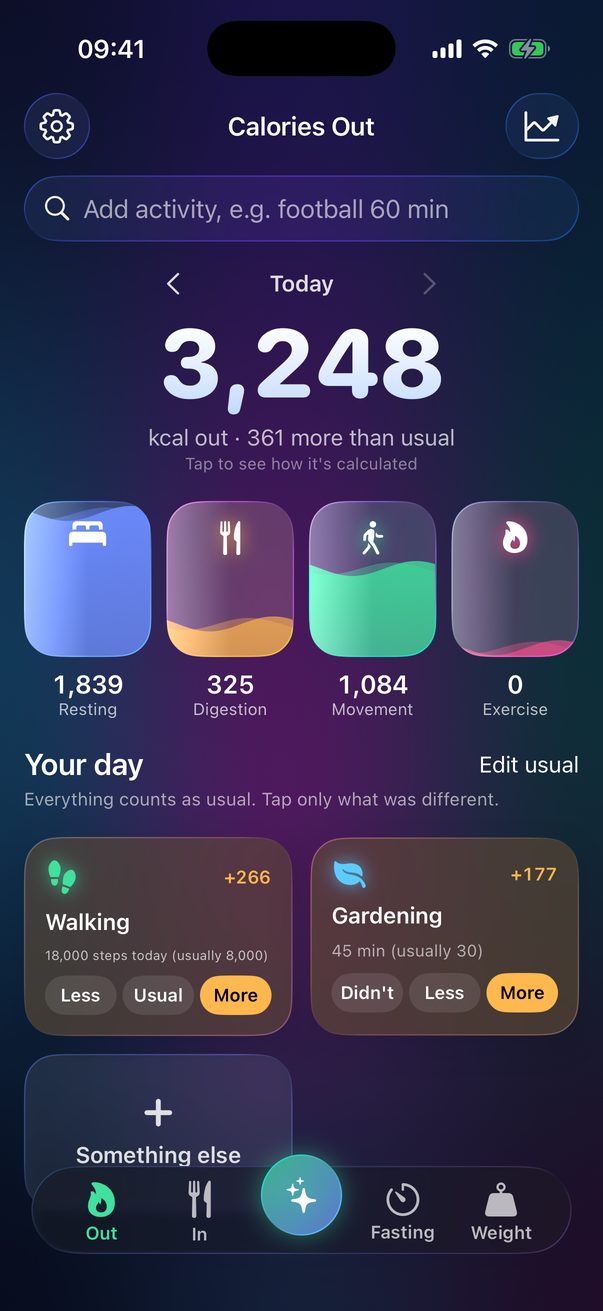
Your day, in four glowing cells.
Every number is tappable down to its formula, with your own figures in it. Nothing is a black box.
Everything counts as usual
Tell it your normal week once — the gym three times, the walk to work. Each day starts as usual. You only tap what was different: Didn't, Less or More.
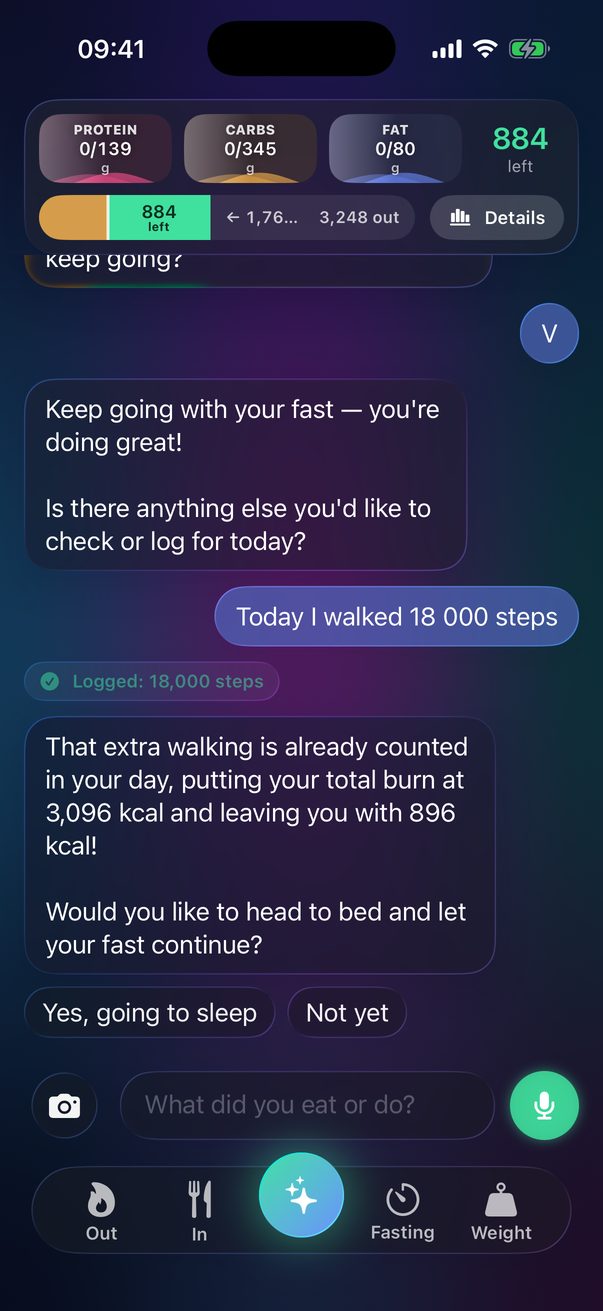
A coach that listens
Say "two eggs and a slice of khachapuri" or send a photo. The coach looks the food up in USDA and Open Food Facts — or the web, for regional dishes — and logs it with protein, carbs and fat. Mention a walk and it adds that too.
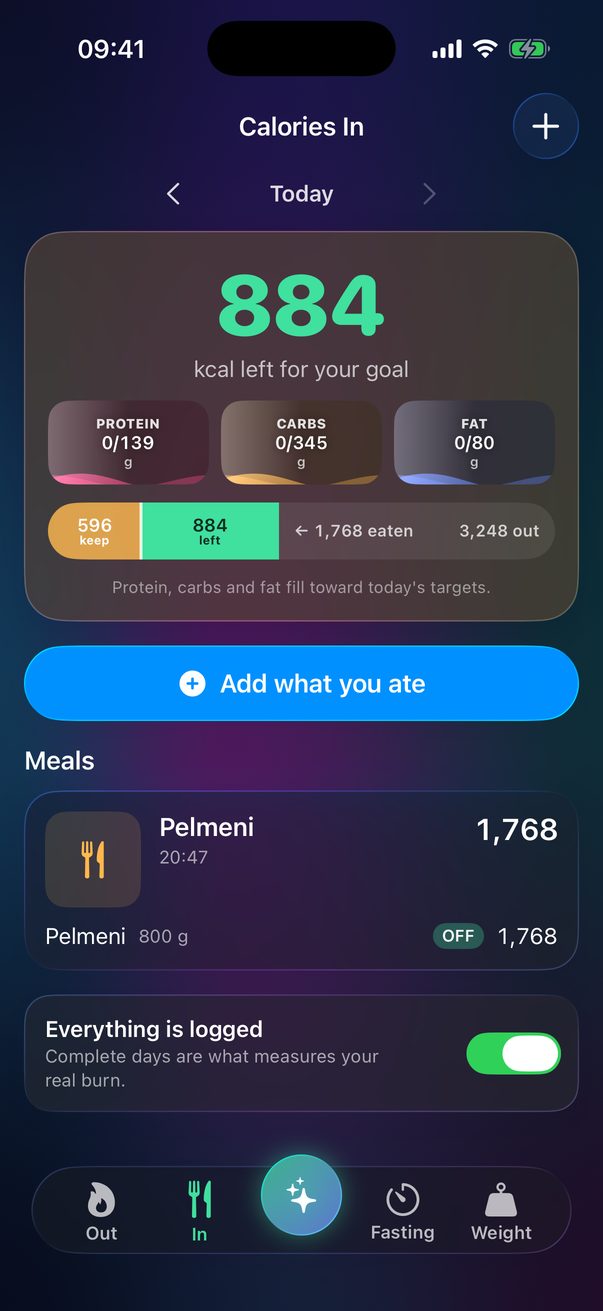
Food spends the day
A single gauge: amber is the deficit your goal keeps in reserve, green is what's left to eat, and it empties right to left as you eat. Protein, carbs and fat fill toward targets built for you.
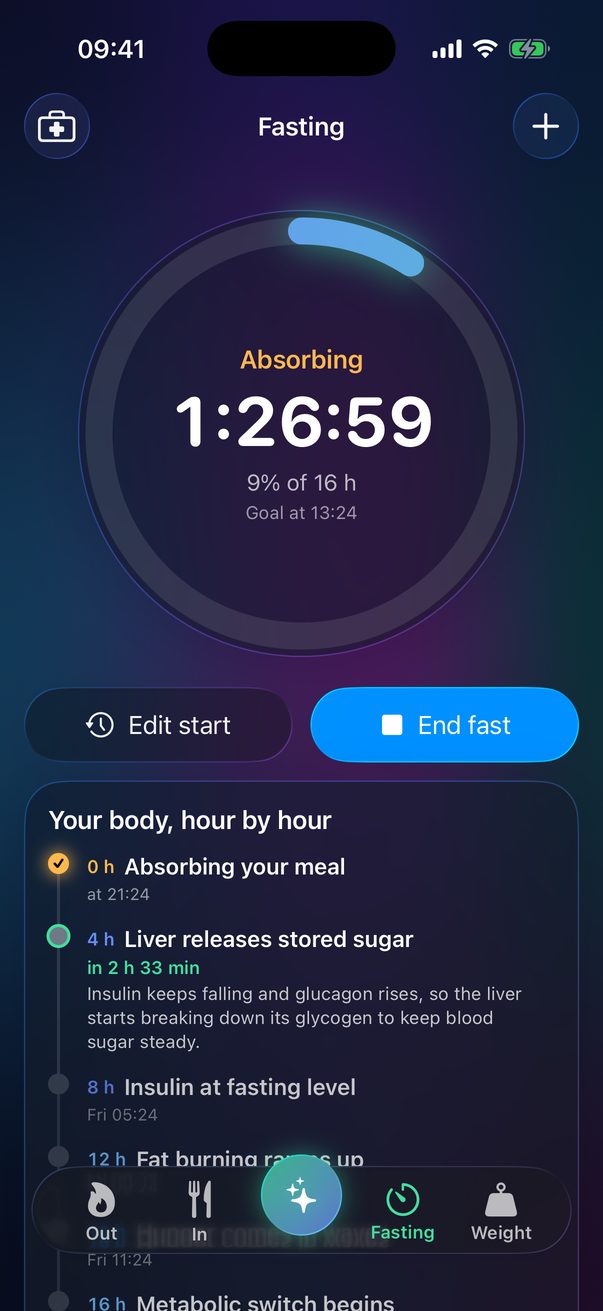
Fasting, hour by hour
One tap starts a fast. A live timeline shows what research says happens in your body — insulin, glycogen, ketones — with every step labelled by how strong the evidence is. Even the honest bit: autophagy timing in humans isn't established.
The gauge
Five tabs. One idea each.
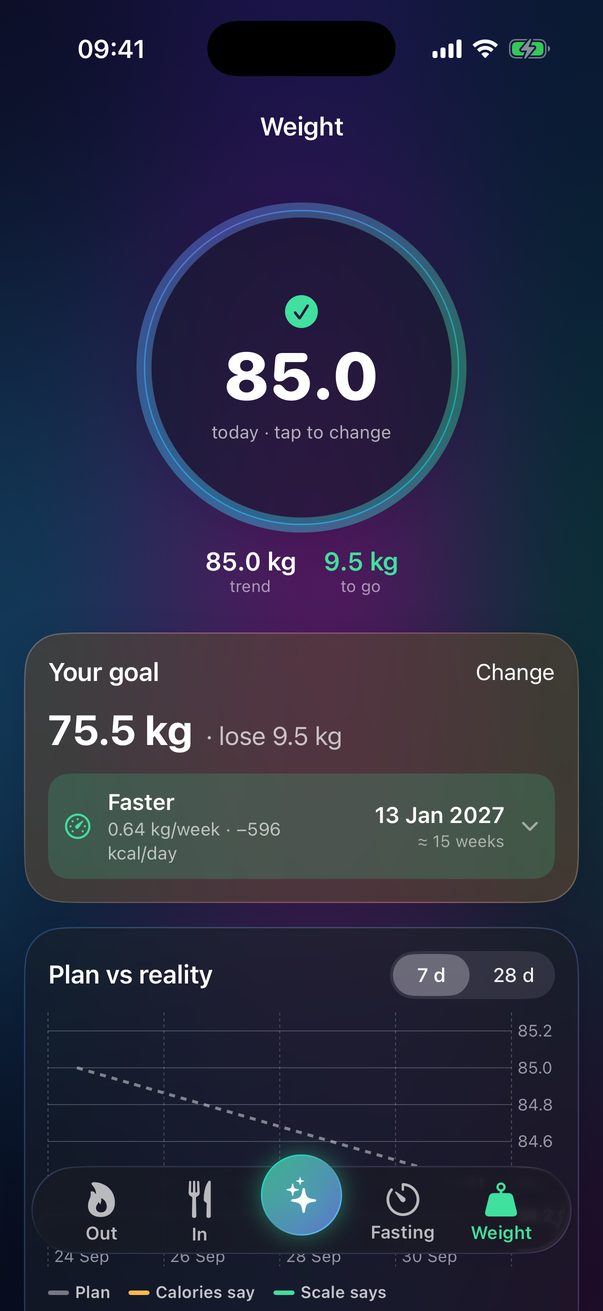
Out · In · Coach · Fasting · Weight — with the coach in the middle, because that's where you talk.
Why it's different
Built on one belief: a number you can't check is a number you can't trust.
| Typical calorie app | Out Calories | |
|---|---|---|
| Your burn | One formula × a guessed activity level | Formula first, then measured from your weight trend |
| Watch calories | Added on top (20–30% off) | Not used — steps and workout times only |
| Exercise | Generic "calories per workout" | 2024 Compendium (1,111 activities), personalised to your resting rate |
| Energy in 1 kg | Always 7,700 kcal | Depends on your body fat (5,900–7,700) |
| Logging food | Search, scroll, pick a portion | Say it or snap it — the coach looks it up |
| Your data | An account on a server | On your iPhone. No account. |
The science, shown
Every figure traces to a published method. Here are the main ones.
Resting energy
Mifflin-St Jeor — within ±10% for about 4 in 5 adults. Lean-mass equations when body fat is measured.
Everyday movement
The FAO/WHO factorial method: work hours at your job's level, the rest of the waking day at home level, plus steps at 0.5 kcal per kg per km.
Measured burn
Average eaten minus the change stored in the body, from a 28-day weight trend. Blended with the formula by how certain each is.
Macros
Protein 1.6–1.8 g per kg of a healthy reference weight (more while losing), fat about 27% of the budget, carbs the rest.
Private by design
No account. No ads. No tracking. Your logs, meals, fasts and weights live in a database on your iPhone. When you use the AI coach, only what it needs to answer goes to Google's Gemini through OpenRouter, under a setting that forbids keeping or training on it — and the app asks before the first time. Read the privacy policy →
Questions
Is it a diet app?
It's a measurement app. It tells you what you burn and what's left for the goal you choose. You decide the goal and the pace — from gentle (0.25% of body weight a week) to faster (1%).
Do I need an Apple Watch?
No. Your iPhone counts steps. With Apple Health connected, steps, morning weight and workouts come in automatically. Without it, you tap Less / Usual / More.
How long until my real burn is measured?
A first estimate after about a week of weigh-ins and logged meals. Reliable in 2–4 weeks. It keeps updating, because your burn changes as your weight does.
Is fasting safe?
For most healthy adults, short fasts are. Some people shouldn't fast without a doctor — read Health & safety. Out Calories gives estimates and explains research; it is not medical advice.
How much does it cost?
Free to download. If paid features come later, they'll be clearly marked and sold through the App Store.